I Put a Walking Pad Under My Desk. Here's What 7 Weeks of Data Says.
I bought a walking pad in the last week of December 2025. I was overseas when it arrived, so it just sat there, waiting. I came back on January 2nd, and started using it on the 3rd.
Seven weeks later, I can say without exaggeration — it's one of the best purchases I've made in years.
The Problem I Was Trying to Solve
I work from home three days a week. The other days, I commute to the office — MRT both ways, which means walking to the station, changing lines, walking to the office, and repeating on the way back. That alone gets you 5–6 km without trying. On WFH days, the errands fill the gap: dropping my daughter to school, fetching her, heading out for lunch, groceries. So I was hitting roughly 10,000 steps a day without any deliberate effort. Not bad on paper.
But on WFH days specifically, I was spending 6–8 hours sitting at a desk, and I could feel it. Not in a dramatic way. Just a slow, creeping heaviness. Brain fog in the afternoons. Low energy by 4 PM. The kind of thing you normalize because everyone around you has it too.
I wasn't looking for a gym. I wasn't looking for a fitness transformation. I was looking for a way to move more during the day, without sacrificing work time.
A walking pad seemed like the answer. I did my research, ran the comparison, and landed on the Kingsmith A1 Pro. Ordered it on Shopee for SGD 429 (after vouchers; listed at SGD 514). Seller: irunning.
No complaints. Zero.
How I Actually Use It
The setup is simple: walking pad under my standing desk, connected to my work machine. I walk during meetings. When I need to speak for more than a minute or two — anything requiring sustained focus or articulation — I pause it. When I'm listening, I'm walking.
Speed: 2.5 km/h during work hours — slow enough to think clearly and type without wobbling. I bump it up to 3.5–4 km/h in the evenings when I'm watching a show and don't need to be cognitively present.
That's it. No complicated routine. No dedicated "workout time." Just — I'm in a meeting, so I'm walking.
One important caveat: I'm not home every day. I work from home only 3 days a week. On office days, I'm at a standing desk — no pad, just standing. Weekends are mostly out with my daughter — parks, events, the usual — so the pad doesn't come into play there either.
Which means the walking pad is realistically contributing maybe 3 days a week. And yet the numbers jumped the way they did. That's the part that genuinely surprised me.
The Numbers Don't Lie
Here's what my step data looks like across the last several months, all from the same tracking app:
| Month | Total Steps | Daily Avg | Notes |
|---|---|---|---|
| Aug 2025 | 323,789 | 10,445 | Before pad |
| Sep 2025 | 305,522 | 10,184 | Before pad |
| Oct 2025 | 294,241 | 9,492 | Before pad |
| Nov 2025 | 307,316 | 10,244 | Before pad |
| Dec 2025 | 307,184 | 9,909 | Before pad (arrived, I was overseas) |
| Jan 2026 | 422,484 | 13,629 | First full month with pad |
| Feb 2026 (till 20th) | 277,660 | 13,883 | Still going |
| Feb 2026 (projected) | ~388,700 | ~13,883 | Based on 20-day avg |
The jump from ~10,000/day to ~13,600+/day happened in one month. Not gradually. Immediately.
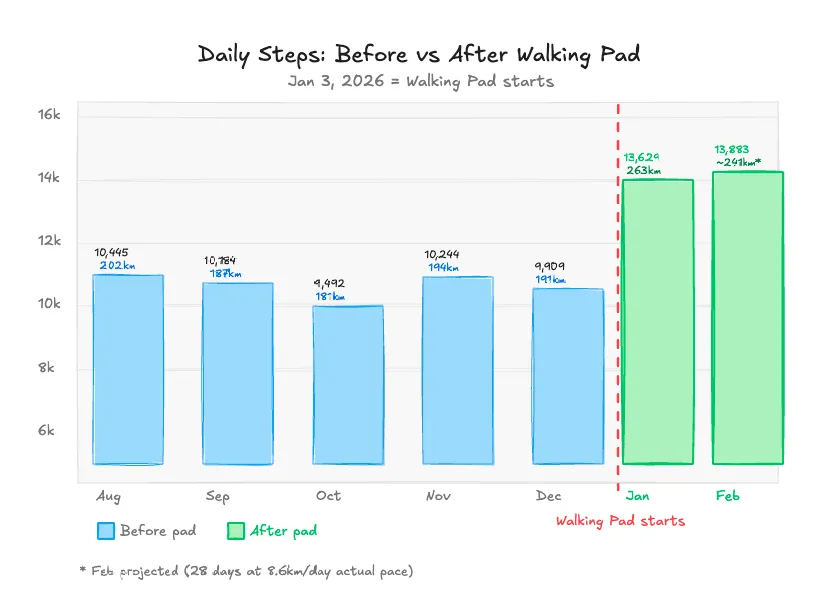
[Chart: Daily Steps & Distance by Month — Aug 2025 to Feb 2026. The green bars (Jan/Feb) are where the walking pad starts. Everything before is blue.]
My fitness app also showed it cleanly: 8.5 km/day in 2026 vs 5.9 km/day in 2025 — a 44% increase in daily distance. And my 5-week average (9 km/day) vs 21-week average (6.3 km/day) tells the same story. The line goes up exactly when the pad came in.
The Streak Factor
One thing I didn't anticipate: the streak became its own motivator.
My app shows a running streak count. On days where I genuinely didn't feel like moving — tired, lazy, just done — the streak was the thing that pushed me to hit at least 10,000 steps. It became a floor. A non-negotiable. Not because someone told me to, but because I didn't want to break the number.
It's a small psychological trick, but it works. The walking pad made the streak easier to maintain. The streak made me want to keep using the walking pad. Positive loop.
There's a spillover effect too. On days I don't use the pad — office days, weekends — I now actively prioritize walking in a way I didn't before. I'll take the longer route, suggest a park with my daughter, choose stairs. I think feeling consistently more energetic has made me want to protect that feeling. The pad didn't just add steps on WFH days. It shifted how I think about movement on every day.
One more thing that helped: communities like r/walkingpad on Reddit. People posting their numbers, sharing setups, talking about what works. Seeing someone clock 20,000 steps on a pad while on a call doesn't make you feel bad — it makes you think "I could do more." Low-key motivating in the best way.
What I Actually Feel Different
I'll be honest about this because it's the part I wasn't expecting.
Meetings feel different. I'm sharper. More present. Less likely to zone out during a long call. I don't know if it's the light movement increasing blood flow, or just the fact that I'm not slumped in a chair — but something is different. I contribute more in meetings I used to drift through.
The afternoon crash is mostly gone. I used to hit a wall somewhere around 3–4 PM. Heavy head, low motivation, reaching for coffee. That's largely disappeared. I'm not claiming the walking pad is magic. But removing 6 hours of pure sitting from my day has clearly done something.
I feel less "stuck." This is harder to quantify. But working from home has a particular kind of energy — or lack of it. You're in the same room, same chair, same screen. The walking pad breaks that physical monotony in a way that a coffee or a lunch break doesn't quite manage.
The Honest Downsides
A few things worth knowing:
It takes up space — but maybe less than you think. The A1 Pro folds, but I rarely bother folding it. It just lives on one side of my standing desk permanently. Chair on the other side. I have a dual monitor arm, so I swing the screens depending on whether I'm sitting or walking. Works fine. That said, we live in an HDB flat — efficient use of space is always on our minds. I specifically didn't buy a treadmill because it would have needed dedicated space and dedicated motivation. The walking pad's whole value is that the barrier is near zero. It's already there. You just step on it.
You can't sprint through focused writing. If I need to type fast, draft something carefully, or do deep code review — I stop the pad. Walking and serious cognitive output don't mix at speed. The sweet spot is listening-heavy meetings and async catchups. (For context: I typed parts of this post while walking at 2 km/h. That works. Deep code review at 4 km/h does not.)
It's not a treadmill. Max speed on the A1 Pro is around 6 km/h. This is not a running machine. It's a slow walking machine. If you want cardio intensity, look elsewhere. If you want to move instead of sit — it's perfect.
Noise. It's relatively quiet, but not silent. My daughter naps in the living room while I use it in the office with the door closed — never once disturbed her. Regular oiling helps keep it quiet; mine is still new so that's not been an issue yet, but it's something to stay on top of long term.
Would I Buy It Again?
Without question.
SGD 429 for something that has tangibly changed how I feel during and after work is a no-brainer. I've spent more on worse ideas.
The walking pad + standing desk combination isn't a fitness hack. It's a work setup upgrade. The fitness benefit is almost a side effect.
If you work from home, spend most of your day in meetings, and feel like your body is staging a slow protest against your lifestyle — this is worth trying. Buy a decent one, set it up properly, and just start walking during your next call.
You'll feel the difference faster than you think.